
Join Backscatter photo pro Ron Watkins on a unique photo expedition to the Galapagos Islands aboard the luxury live-aboard dive boat Galapagos Sky.
Gently swept by the waters of three major oceanic currents, the Galapagos Islands provide a stunning range of extraordinary diving encounters for live-aboard divers.

Schooling Hammerheads, giant whale sharks, rays of all shapes and colors, turtles, huge schools of fish, Galapagos fur seals, and astounding marine life diversity are just some of the riveting attractions of Galapagos liveaboard diving – a destination many divers feel is “the best in the world”.

Whale sharks (Rhincodon typus) are the largest fish in the sea, and large adults may reach 40 ft. (12.2 m) in length, and mature adults are typically 30+ ft (10 m) in length. They may weigh 40,000 lbs or more. Only a few of the great whales (mammals) are larger.

There’s really nothing like the thrill of finding and seeing a whale shark in their natural habitat. Their size alone delivers an unforgettable impression. They are also often accompanied by a host of other sea denizens: remoras, cleaner fish, tuna, mackerel… Large whale sharks bring a mini-ecosystem along for the ride.

“Sky” has cruised the islands of the Galápagos Archipelago for nearly a decade – providing thousands of divers with high-octane, extraordinary Galápagos diving experiences. Our Galapagos live-aboard cruises also offer a full line-up of luxury accommodations, excellent food, “extra touch” amenities, and a friendly, helpful staff.

M/V Galapagos Sky’s dive deck was designed with divers’ needs in mind. Camera table, charging station for camera batteries, hot showers, bathroom, separate rinse bins for wetsuits, and separate rinse bins for cameras. Each dive station has individual bin storage under the seat. Dive deck towels are labeled with numbers to coordinate with the diver’s seat location. Towels are heated. Accommodations include eight private en-suite cabins with two twin-bed or one king-size bed options. Each cabin features a private head/shower, mirrored cabinet and wardrobe, bathrobes, a hairdryer, and marine-safe (biodegradable) toiletries.
Master Stateroom cabins 1-4 are located on the Dolphin deck and have two twin beds (that can be joined together), private facilities, a window view, a mirrored cabinet, a wardrobe, bathrobes, a hairdryer, biodegradable toiletries, fresh towels daily, air conditioning, and volume controls.
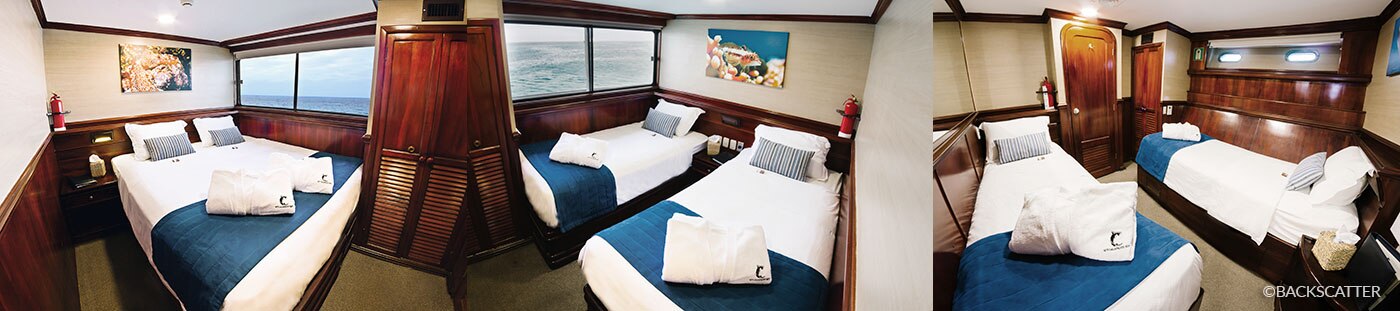
Deluxe Staterooms 5-8 are located on the Iguana deck and have two twin beds, private facilities, a Port light view, a mirrored cabinet, a wardrobe, bathrobes, a hairdryer, biodegradable toiletries, fresh towels daily, air conditioning, and volume controls.


Divers must be comfortable in these conditions, as well as have very good buoyancy control and be able to do negative (sometimes rapid) back-roll entries/descents from small boats. Recommended requirements include 50-100 open-water dives, experience with currents, ability to remove gear in the water, and ability to get into small boats (inflatable tenders) in choppy seas.


Please note that medical evacuation insurances such as Dive Assure or Divers Alert Network (DAN) is mandatory on all trips.
Additionally, comprehensive Cancellation, Accident, Medical and Baggage insurance such as DAN, Dive Assure, or Generali Global Assistance is highly recommended.
This will be your first underwater introduction to Galapagos sea lions and fur seals! Watch them Zoom in and out and dance playfully for you!
Even on the first day of your liveaboard cruise, you begin to see the myriad and diverse land formations that comprise the Galapagos Islands’ topside. It is then that you realize you will see nothing like it in your lifetime.
Cousins Rocks is a top dive site featuring a stunning wall, black corals, and abundant marine life. Expect to see frogfish, seahorses, scorpionfish, octopuses, and large schools of barracuda. Sea lions often accompany divers during safety stops. The site offers minimal current.
Diving Wolf and Darwin
You’ll spend the next three days diving (up to four dives per day plus a night dive) on the legendary islands of WOLF & DARWIN.
Gently swept by the waters of three major oceanic currents, the Galapagos Islands provide a stunning range of extraordinary diving encounters for live-aboard divers.
Schooling Hammerheads, giant whale sharks, rays of all shapes and colors, turtles, huge schools of fish, Galapagos fur seals, and astounding marine life diversity are just some of the riveting attractions of Galapagos liveaboard diving – a destination many divers feel is “the best in the world”.
Whale Shark Season
While you may see whale sharks during any cruise on M/V Galapagos Sky, the number of encounters goes up dramatically during WHALE SHARK SEASON – JUNE THROUGH NOVEMBER of every year.
Whale sharks (Rhincodon typus) are the largest fish in the sea, and large adults may reach 40 ft. (12.2 m) in length, and mature adults are typically 30+ ft (10 m) in length. They may weigh 40,000 lbs or more. Only a few of the great whales (mammals) are larger.
There’s really nothing like the thrill of finding and seeing a whale shark in their natural habitat. Their size alone delivers an unforgettable impression. They are also often accompanied by a host of other sea denizens: remoras, cleaner fish, tuna, mackerel… Large whale sharks bring a mini-ecosystem along for the ride.
Galapagos Sky
The luxury live-aboard M/V Galapagos Sky is a 100 ft. (33m) state-of-the-art live-aboard diving yacht exploring the fabled waters of the Galapagos Islands.“Sky” has cruised the islands of the Galápagos Archipelago for nearly a decade – providing thousands of divers with high-octane, extraordinary Galápagos diving experiences. Our Galapagos live-aboard cruises also offer a full line-up of luxury accommodations, excellent food, “extra touch” amenities, and a friendly, helpful staff.
M/V Galapagos Sky’s dive deck was designed with divers’ needs in mind. Camera table, charging station for camera batteries, hot showers, bathroom, separate rinse bins for wetsuits, and separate rinse bins for cameras. Each dive station has individual bin storage under the seat. Dive deck towels are labeled with numbers to coordinate with the diver’s seat location. Towels are heated. Accommodations include eight private en-suite cabins with two twin-bed or one king-size bed options. Each cabin features a private head/shower, mirrored cabinet and wardrobe, bathrobes, a hairdryer, and marine-safe (biodegradable) toiletries.
Master Stateroom cabins 1-4 are located on the Dolphin deck and have two twin beds (that can be joined together), private facilities, a window view, a mirrored cabinet, a wardrobe, bathrobes, a hairdryer, biodegradable toiletries, fresh towels daily, air conditioning, and volume controls.
Deluxe Staterooms 5-8 are located on the Iguana deck and have two twin beds, private facilities, a Port light view, a mirrored cabinet, a wardrobe, bathrobes, a hairdryer, biodegradable toiletries, fresh towels daily, air conditioning, and volume controls.
Diving Conditions
Please note that diving in the Galapagos is advanced due to strong currents, varying visibility, and cold water. Temperatures in October range from the low 60s to the upper 70s across different areas of the itinerary. A 7mm wetsuit with a hood, vest, and gloves are recommended.
Divers must be comfortable in these conditions, as well as have very good buoyancy control and be able to do negative (sometimes rapid) back-roll entries/descents from small boats. Recommended requirements include 50-100 open-water dives, experience with currents, ability to remove gear in the water, and ability to get into small boats (inflatable tenders) in choppy seas.
Land Excursions
During your time in the central islands, you’ll also walk in the steps of Charles Darwin, with 3 guided land excursions. Your first land experience is on North Seymour Island, renowned for its iconic blue-footed boobies and magnificent frigate birds. You will also visit the Highlands in Santa Cruz later in the cruise to search for Galápagos tortoises in their natural habitat, and later in the day, you can finish this excursion with an unguided visit to the Charles Darwin Research Center during free time in the port area. Lastly, on Sunday morning, our guests will explore the Interpretation Center in San Cristóbal, where much about the Galápagos’ history and conservation efforts can be learned. This visit occurs just before your return flight to Ecuador.
Getting There
You can fly to the Galapagos from either Quito or Guayaquil, Ecuador. Both cities are serviced by many major US airlines. You’ll need to arrive at least 1 day before your flight to the Galápagos, but we recommend arriving 2 days early in case of any travel delays or lost luggage. If you miss the flight to Galapagos, you’ll miss the entire trip. We can arrange tours and activities in Ecuador, along with hotel and domestic flights to the Galápagos.Trip: September 12-19, 2027
Travel info:
- September 11 (or earlier): Arrive in Quito or Guayaquil
- September 12: Fly to the Galapagos Islands and board the Galapagos Sky
- September 19: Disembark and fly back to Quito or Guayaquil
- September 20(or later): Fly home
Standard Package Includes:
- 7 nights aboard the Galapagos Sky, double occupancy
- All meals & snacks
- All beverages, soft drinks, beer, wine, spirits, and liquors
- Diving – up to 4 dives per day
- Nitrox
- 3 land excursions
- Airport transfers
- Taxes
Pricing:
- $7,495 per person in a Deluxe Cabin
- $7,795 per person in a Master Cabin
Additional costs:
- Galapagos National Park fee $200
- Transit card $20
- Chamber fee $35
- International airfare to Quito (UIO) or Guayaquil (GYE)
- Domestic airfare to the Galapagos Islands
- Accommodations before and after the cruise
- Trip interruption or cancellation insurance
- Dive accident insurance
- Rental gear
- Crew tip
Please note that medical evacuation insurances such as Dive Assure or Divers Alert Network (DAN) is mandatory on all trips.
Additionally, comprehensive Cancellation, Accident, Medical and Baggage insurance such as DAN, Dive Assure, or Generali Global Assistance is highly recommended.
Itinerary
Sunday, September 12: (Embarkation day):
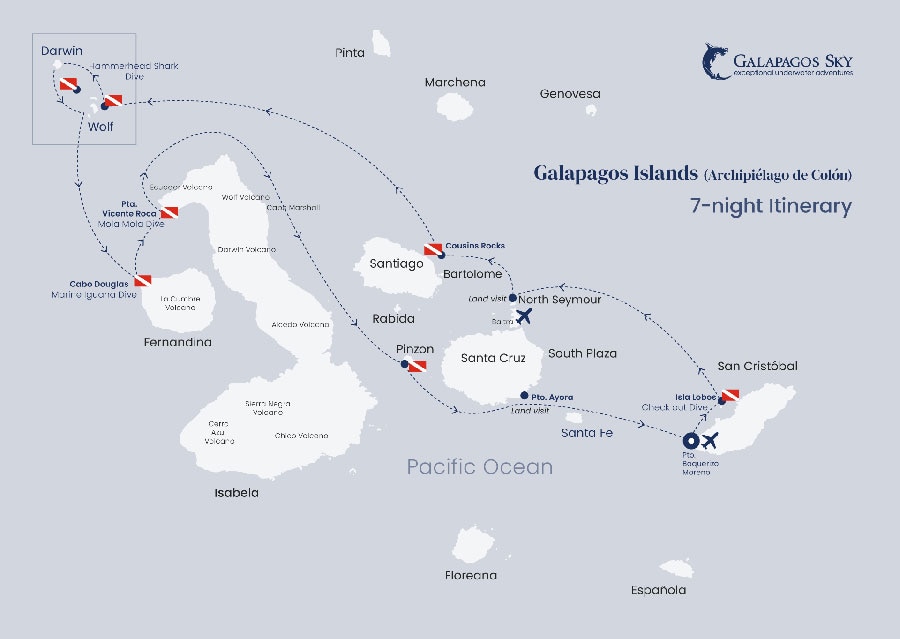
Isla Lobos- Check out dive
When you arrive at the airport in San Cristobal on Sunday (Avianca flight 1636), the crew of the Galapagos Sky will personally meet you, collect your luggage, and escort you to the Galapagos Sky. Your luggage will be delivered to the dive deck for you. After everyone is on board, we will introduce you to the boat and do our mandatory safety briefings and drills. Then, we cruise to the area of Los Lobos for your check-out dive.This will be your first underwater introduction to Galapagos sea lions and fur seals! Watch them Zoom in and out and dance playfully for you!
Even on the first day of your liveaboard cruise, you begin to see the myriad and diverse land formations that comprise the Galapagos Islands’ topside. It is then that you realize you will see nothing like it in your lifetime.
Monday
1 land visit and 2 dives
Start your day with a full breakfast, followed by a land visit to North Seymour. After lunch, enjoy some relaxation time and dive briefings before heading out for Dive 2 and Dive 3 at Cousins Rock.AM North Seymour / PM Cousins Rock
North Seymour Island is renowned for its iconic blue-footed boobies and magnificent frigate birds. Visitors frequently witness the blue-footed booby’s elaborate courtship dance, where males showcase their bright blue feet to attract mates. The island is also a prime spot for observing the magnificent frigate bird’s striking red throat pouch during courtship displays. Additionally, you’ll encounter vibrant land iguanas and playful sea lions, making it a truly memorable wildlife experience.Cousins Rocks is a top dive site featuring a stunning wall, black corals, and abundant marine life. Expect to see frogfish, seahorses, scorpionfish, octopuses, and large schools of barracuda. Sea lions often accompany divers during safety stops. The site offers minimal current.
Tuesday-Thursday: Wolf & Darwin
Tues – 4 Dives a day at Wolf plus a night dive
Wed – 4 dives at Darwin
Thurs – 3 Dives total, 2 at Darwin and 1 afternoon dive at Wolf before long transit back to central islands
Diving Wolf and Darwin
You’ll spend the next three days diving (up to four dives per day plus a night dive) on the legendary islands of WOLF & DARWIN.
Most experienced divers will agree, Wolf and Darwin can provide some of the best diving encounters in the world! Whale sharks are common here from mid-May through November. At The Pillars (former Arch) at Darwin, you will see hammerhead sharks either individually, in small groups, or in large schools. Bottlenose dolphins are common. The reef contains many warm-water fish species found nowhere else in the Islands.
Once you see Wolf and Darwin, you’ll immediately understand why there are no shore excursions on this part of the cruise – there is no way up the vertical cliffs!
Darwin Island: Considered by many experienced divers as the very best dive site in the world, The Pillars at Darwin Island honors its reputation. It is a few degrees warmer than the central islands. In a single dive, you can find schooling hammerhead sharks, Galápagos sharks, large pods of dolphins, thick schools of skipjack and yellowfin tuna, bigeye jacks, mobula rays, and silky sharks. From June to November, it is not uncommon to encounter whale sharks in multiple numbers on one single dive. The presence of occasional tiger sharks, black and blue marlin, and killer whales adds to this amazing diving experience. If you still have time to look for smaller stuff, you’ll find octopus, flounders, and an enormous variety and abundance of tropical fish. Darwin Island is the biggest jewel on the Galapagos Crown.
Wolf Island: One of those magical islands, with several dive sites to choose from. If you want to see sharks, youare in the right spot. This is a place for schooling hammerhead sharks, large aggregations of Galápagos sharks, and, occasionally, whale sharks. Seeing dolphins, large schools of tuna, spotted eagle rays, barracudas, sea lions, and sea turtles is common. The bottom is littered with hundreds of moray eels, many of them free swimming. Being several degrees warmer than the central islands, you can look for many representatives of the Indo-Pacific underwater fauna. On a night dive here, you will also enjoy spotting and watching the Red-Lipped batfish walk along the bottom of the sea!
Friday
Cabo Douglas 1 dive – Marine iguana dive
Punta Vicente Roca up to 2 dives and Panga ride if time allows.
Cabo Douglas: On the western side of Fernandina Island, we will do 1 dive on Friday morning. Here you can expect to see Galápagos Penguins, Marine Iguanas, Flightless Cormorants, Sea Lions, Seahorses, Sea Turtles, Horn Sharks, Red-Lipped Batfish, and occasional hammerhead and white-tip sharks. Also, keep an eye out for chevron barracuda, snappers, yellow fin tuna, rainbow runners, and wahoo. There are also many smaller fishes, such as creole fishes, parrot fishes, scrawled filefishes, pacific box fishes, and tiger snake eels.
Punta Vincente Roca: Our coldest yet rapidly increasing favorite dive – steep, deep vertical wall covered in soft coral, sponges, and endemic black coral. Regular sightings of mola mola (oceanic sun fish) sea horses, bullhead sharks, red-lipped batfish, various shrimp, and many other marine invertebrates. Keep your eyes open for fly-bys from the flightless cormorants, penguins, and maybe even a marine iguana. Our after-dive panga ride offers great topside photo ops for penguins, flightless cormorants, marine iguanas, sea lions, blue-footed & Nazca booby Birds, magnificent frigates, and noddy terns. The diving here is chilly (particularly below the thermocline), but not to be missed!
Saturday
Northeast tip of Isla Pinzon/Islote Dumb- 1 dive
Puerto Ayora/Highlands tour
Isla Pinzon: While diving on Isla Pinzon, you will have opportunities to encounter a variety of shark, sea lion, manta, eagle ray, and moray eel species. Many Species of fish and tropicals, including yellow-tailed surgeonfish, king angelfish, moorish idols, steel pompanos, snappers, grunts, creole fish, and barracuda.
This dive is then followed by a transit to Itabaca Channel, where guests will be transferred by bus to visit the Highlands of Santa Cruz to see the Galápagos tortoises in their natural environment, and to Puerto Ayora. Guests will then be transferred back to Itabaca Channel to board the Galapagos Sky for dinner on board. The Sky will then return to San Cristobal for Sunday morning cruise completion.
Sunday
Morning – Land Tour and Day of Departure
Interpretation center.
Arrive San Cristobal—(Land Excursion) visit the Interpretation Center, where an interesting human history of the Galápagos is presented; town walk (last chance for shopping). Late morning departure to the airport

 Ron Watkins is a professional photographer, writer, explorer, trip leader and photography instructor specializing in underwater and topside nature photography. Through his imagery, Ron is committed to raising awareness of the challenges facing our fragile ecosystems and threatened marine life in hopes of promoting conservation. Ron is known as an adventurer who is passionate about sharing his knowledge of photography techniques and helping his clients capture images of unique subjects and behavior.
Ron Watkins is a professional photographer, writer, explorer, trip leader and photography instructor specializing in underwater and topside nature photography. Through his imagery, Ron is committed to raising awareness of the challenges facing our fragile ecosystems and threatened marine life in hopes of promoting conservation. Ron is known as an adventurer who is passionate about sharing his knowledge of photography techniques and helping his clients capture images of unique subjects and behavior.